

本篇笔记文档名 👇

•27英语-小谭唐迟+斌斌阅读技巧组合✔
本文档为考研英语阅读解题技巧总结,涵盖唐迟和颉斌斌的核心方法。重点讲解干扰选项特征(信息拼凑型)、阅读逻辑黄金法则(最优选)及多题型解题策略:例证题需定位例子前后观点,态度题关注首尾串读与情态动词后观点,推理题侧重细节改写与转折,词汇题结合同义反义逻辑。通过2021年及2023年真题示例(如印尼CCT项目、德州气候教育争议)解析,帮助考生掌握题干定位、选项对比及主旨串联技巧,适用于英语一、二备考者提升阅读正确率。
文档的预览图如下,需要完整PDF文件的同学,文末有文档编码,保存后即可直接打印使用。
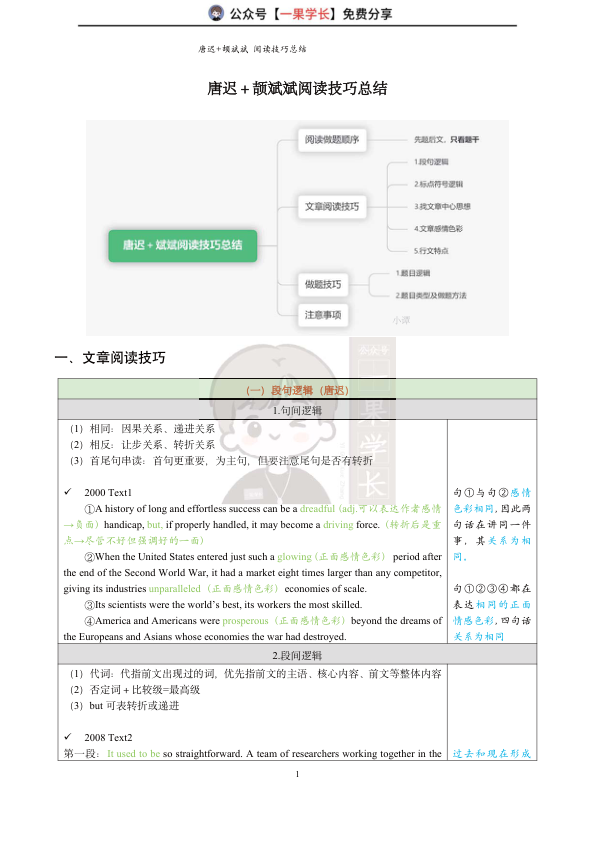
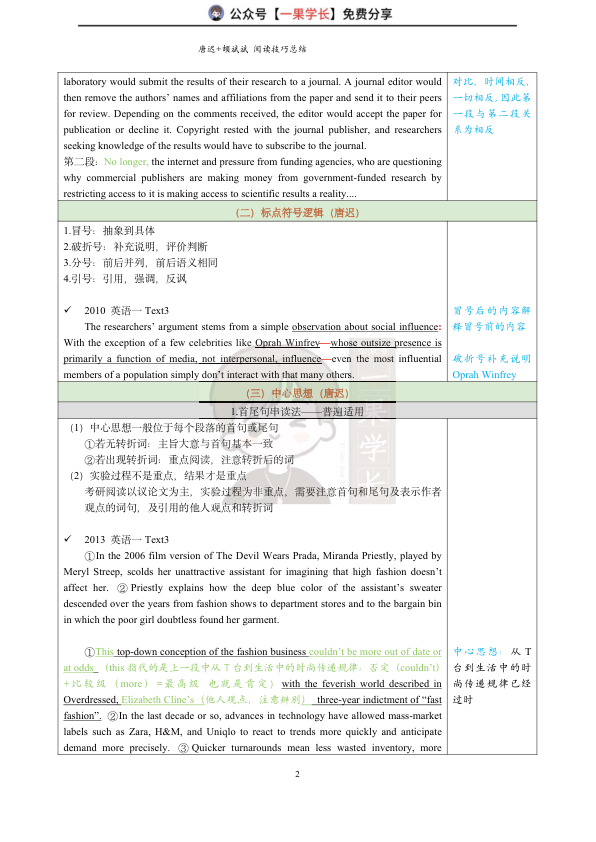
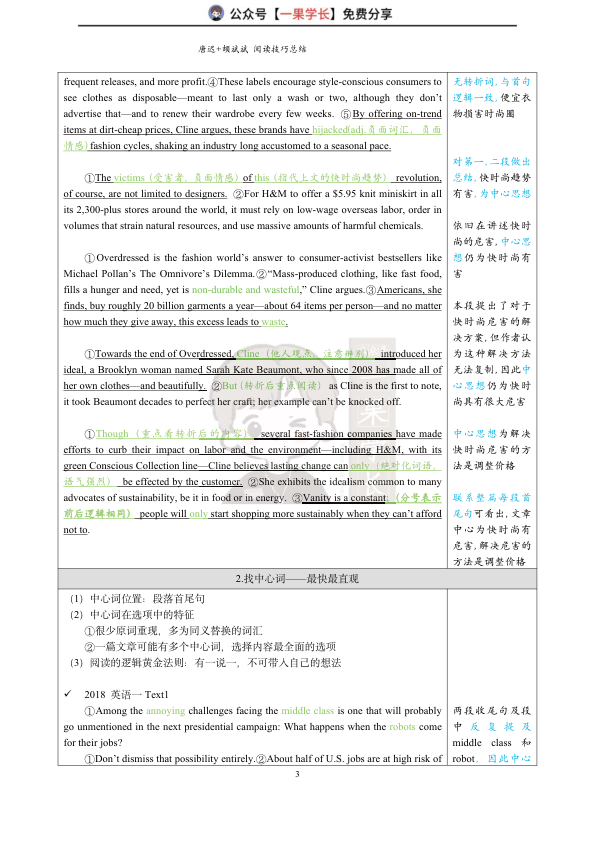
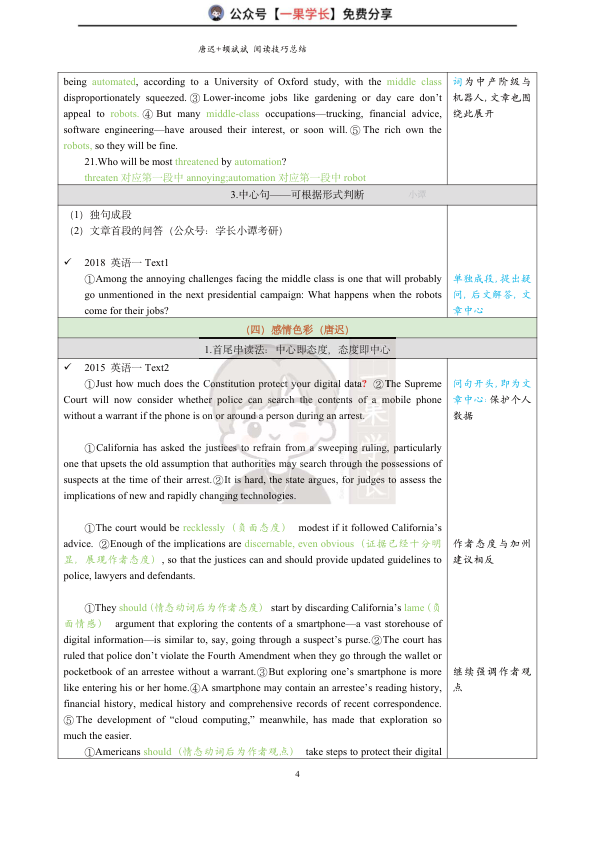
📑27英语-小谭唐迟+斌斌阅读技巧组合
示例1:英语一2021年Text2
Last year marked the third year in a row of when Indonesia’s bleak rate of deforestation has slowed in pace. One reason for the turnaround may be the country’s antipoverty program. In 2007, Indonesia started phasing in a program that gives money to its poorest residents under certain conditions, such as requiring people to keep kids in school or get regular medical care called conditional cash transfers or CCTs, these social assistance programs are designed to reduce inequality and break the cycle of poverty. They’re already used in dozens of countries worldwide. In Indonesia, the program has provided enough food and medicine to substantially reduce severe growth problems among children.
But CCT programs don’t generally consider effects on the environment. In fact, poverty alleviation and environmental protection are often viewed as conflicting goals, says Paul Ferraro, an economist at Johns Hopkins University.
That’s because economic growth can be correlated with environmental degradation, while protecting the environment is sometimes correlated with greater poverty. However, those correlations don’t prove cause and effect. The only previous study analyzing causality, based on an area in Mexico that had instituted CCTs, supported the traditional view. There, as people got more money, some of them may have more cleared land for cattle to raise for meat, Ferraro says.
Such programs do not have to negatively affect the environment, though. Ferraro wanted to see if Indonesia’s poverty-alleviation program was affecting deforestation. Indonesia has the third-largest area of tropical forest in the world and one of the highest deforestation rates.
Ferraro analyzed satellite data showing annual forest loss from 2008 to 2012-including during Indonesia’s phase-in of the antipoverty program-in 7,468 forested villages across 15 provinces. “We see that the program is associated with a 30 percent reduction in deforestation,” Ferraro says.
That’s likely because the rural poor are using the money as makeshift insurance policies against inclement weather, Ferraro says. Typically, if rains are delayed, people may clear land to plant more rice to supplement their harvests.
Whether this research translates elsewhere is anybody’s guess. Ferraro suggests the results may transfer to other parts of Asia, due to commonalities such as the importance of growing rice and market access. And regardless of transferability, the study shows that what’s good for people may also be good for the environment. Even if this program didn’t reduce poverty, Ferraro says, “the value of the avoided deforestation just for carbon dioxide emissions alone is more than the program costs.”
26. According to the first two paragraphs, CCT programs aim to
[A] facilitate healthcare reform.
[B] help poor families get better off.
[C] improve local education systems.
[D] lower deforestation rates.
27. The study based on an area in Mexico is cited to show that
[A] cattle raising has been a major means of livelihood for the poor.
[B] CCT programs have helped preserve traditional lifestyles.
[C] antipoverty efforts require the participation of local farmers.
[D] economic growth tends to cause environmental degradation.
28.In his study about Indonesia, Ferraro intends to find out
[A] its acceptance level of CCTs.
[B] its annual rate of poverty alleviation.
[C] the relation of CCTs to its forest loss.
[D] the role of its forests in climate change.
29. According to Ferraro, the CCT program in Indonesia is most valuable in that
[A] it will benefit other Asian countries.
[B] it will reduce regional inequality.
[C] it can protect the environment.
[D] it can benefit grain production.
30.What is the text centered on?
[A] The effects of a program.
[B] The debates over a program.
[C] The process of a study.
[D] The transferability of a study.
1️⃣ 关注果哥公众号【一果学长】

2️⃣ 公众号后台回复“目录”查看
声明:本站所有文章,如无特殊说明或标注,均为本站原创发布。任何个人或组织,在未征得本站同意时,禁止复制、盗用、采集、发布本站内容到任何网站、书籍等各类媒体平台。如若本站内容侵犯了原著者的合法权益,可联系我们进行处理。